
Reading Controls
Customize your reading experience
Switch between light and dark themes
Adjust text size and spacing for comfort
Getting Hired at an Indian Startup: Finding & Pitching the Right Opportunities
Getting Hired at an Indian Startup: Finding & Pitching the Right Opportunities
Most people approach startup job hunting completely backwards.
They wait for the perfect job posting that matches their exact experience. They only apply to companies in Bangalore. They assume if there's no open role, there's no opportunity.
Meanwhile, the best opportunities are hiding in plain sight – and most candidates never even look for them.
This is Part 3 in our 5-part series on "Getting Hired at an Indian Startup." If you haven't read Part 1 and Part 2, start there.
The Opportunity Paradox
Here's what's frustrating: while you're scrolling through Naukri looking for the "perfect" PM role, there are dozens of startups that desperately need someone like you but haven't posted a job yet.
Why? Because hiring is hard. Writing job descriptions is hard. Reviewing 2,600 applications is hard.
Many founders would rather hire someone who shows up with genuine interest and demonstrates capability than post another job and deal with the avalanche of generic applications.
But nobody's taught you how to find and pitch these hidden opportunities.
Finding Great Opportunities: Where to Actually Look
Forget the traditional job boards for a moment. Here's where the real opportunities are:
1. Companies Backed by Indian VCs
Start with the portfolio pages of top Indian VCs:
- Sequoia Capital India / Peak XV Partners
- Accel India
- Matrix Partners India
- Lightspeed India
- Blume Ventures
- Kalaari Capital
- Elevation Capital (formerly SAIF Partners)
These VCs publish their portfolio companies publicly. Browse through them. You'll find companies at different stages, seed, Series A, Series B. Early-stage companies (seed to Series A) are often more open to unconventional hiring approaches.
2. Recently Funded Companies
Use platforms like:
- YourStory (check their funding announcements)
- Inc42 (weekly funding roundups)
- Entrackr (detailed funding coverage)
- VCCircle (comprehensive funding database)
Why recently funded companies? They just got capital. They're planning to scale. They're about to hire aggressively. Getting in before they post the role gives you a massive advantage.
3. Fast-Growing Sectors
Focus on sectors that are actively growing in India:
- Fintech: Digital payments, lending, wealth management, insurance tech
- Edtech: K-12, test prep, upskilling, corporate training
- D2C: Beauty, fashion, food, home goods
- Healthcare: Telemedicine, pharmacy, diagnostics
- B2B SaaS: Tools for Indian businesses
- Quick Commerce: 10-minute delivery, hyperlocal services
These sectors are hiring constantly, even if roles aren't always posted publicly.
4. PM Interview Prep Club's Job Board
Shameless plug, but we curate opportunities specifically for aspiring till mid-senior PMs at Indian startups. Companies that post with us are actively looking and often more receptive to candidates from our community.
5. Your Own Network
Ask around. Post on LinkedIn. DM people working at startups you're interested in. The Indian startup ecosystem is more connected than you think.
One mentee got hired at a Series B startup by simply asking on LinkedIn: "Does anyone here work at a growing fintech startup in Bangalore that might need a PM?" Three people DMed her with intros.
Breaking the Rules for Startups: Why Most "Requirements" Don't Actually Matter
Here's where you need a mindset shift.
Most job postings are wish lists, not requirements. And many of the best opportunities don't even have job postings yet.
"But they want 5 years of experience, and I only have 2."
Apply anyway. If you can demonstrate product thinking and deliver value (using the tactics from Blog 2), experience becomes less important.
We've seen people with 1 year of experience get PM roles asking for 5+ years. Why? Because they showed up with customer insights, competitive analysis, and product ideas that were better than what candidates with 7 years of experience submitted.
"But I don't live in Bangalore."
Post-COVID, many startups are more open to remote work. Some are opening offices in other cities. Some will consider relocating the right candidate.
Don't self-reject. Apply, demonstrate value, and if they're interested, figure out the logistics together.
One of our mentees was based in Jaipur and got hired by a Bangalore-based healthtech startup. How? She did exceptional customer research in Tier 2 cities (which the Bangalore-based team couldn't easily access) and turned it into a strategic advantage.
"But there's no open PM role listed."
This is the biggest opportunity everyone misses.
Many startups are "always hiring" for exceptional people, even if they don't have an active job posting. If you show up with genuine value and demonstrate you understand their business, they'll often create a role.
Think about it from their perspective: finding good people is hard. If someone shows up who clearly understands the market, has done their homework, and is demonstrating initiative, why wouldn't they at least have a conversation?
The worst that happens? They say, "not now, but keep in touch." The best that happens? They create a role for you.
The Product Strategy Memo: Your Secret Weapon
Now, here's how you actually pitch yourself when you've found the right opportunity.
Forget cover letters. Write a Product Strategy Memo instead.
A Product Strategy Memo is a 1-2 page document that demonstrates:
- You understand their business
- You can think strategically about their product
- You can provide immediate value
This is what gets you in the door. This is what gets forwarded to the founder. This is what starts real conversations.P.S. One of our mentees tried this approach with a Series A Fintech startup known for very stringent shortlisting criteria, and he secured a call directly with the founders.
The "How to Be Valuable" Framework
Before writing anything, understand this: companies care about three things.
1. Acquire New Users: How can you help them get more customers? This could be through new channels, partnerships, product features that enable virality, or entering new segments.
2. Increase Engagement/Retention: How can you help existing users get more value and stick around longer? This could be through improving onboarding, adding engaging features, building habits, or creating network effects.
3. Improve Unit Economics: How can you help them make more money per customer or reduce costs? This could be through monetization strategies, reducing churn, increasing lifetime value, or improving operational efficiency.
Every idea you propose should map to at least one of these three categories. If it doesn't, it's probably not strategic enough.
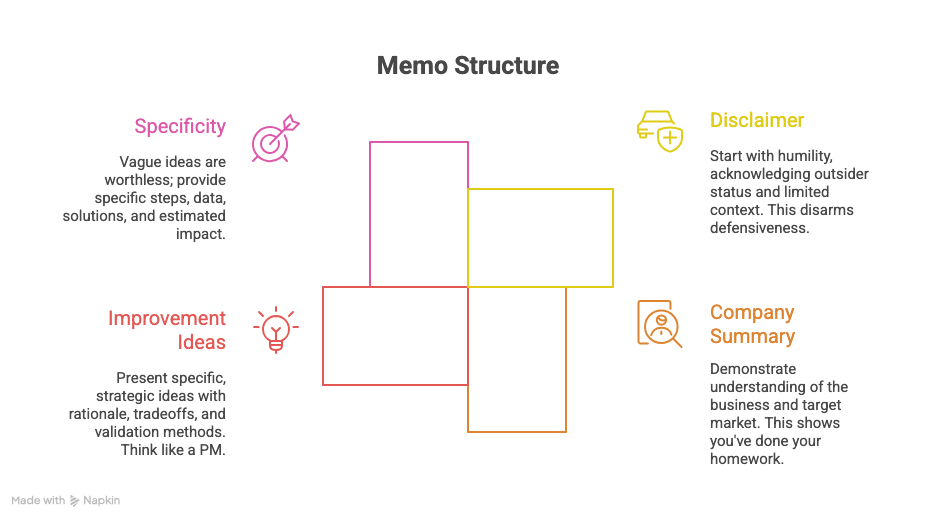
The Memo Structure
Here's the framework that works:
1. Disclaimer (2-3 sentences)
Start with humility. You're an outsider. You don't have all the context.
Example: "I'm writing this as someone who's spent the last week studying your product and talking to a few users. I don't have internal context on your roadmap or constraints, so some of these ideas might not be feasible. But I wanted to share my thinking in case it's helpful."
This disarms defensiveness and shows self-awareness.
2. Company & Target Market Summary (1 paragraph)
Demonstrate that you understand their business and who they serve.
Example: "Abcd is a fintech app helping Tier 2/3 city users invest in mutual funds. Your primary users are first-time investors aged 25-40 with household incomes of ₹5-15 LPA who are digitally literate but financially inexperienced. From what I can see, your core value prop is simplifying investing through vernacular language support and small SIP amounts."
This shows you've done your homework.
3. Ideas for Improvement (The Bulk of Your Memo)
Present 3-5 specific, strategic ideas. For each idea:
- State the idea clearly: What are you proposing?
- Explain the strategic rationale: Why would this help the business? Which of the three value drivers does it address?
- Show you understand the tradeoffs: What would be hard about this? What would need to be true for this to work?
- Suggest how to validate: How could they test this before full implementation?
Example: *"Idea 1: Launch a 'Buddy Referral' Program with Shared Milestones
Currently, referrals offer ₹100 to both referrer and referee after the first investment. This is transactional and doesn't leverage the social dynamic of learning about investing together.
Strategic Rationale: This addresses user acquisition and retention simultaneously. Tier 2/3 users often learn about money from family and friends, not from formal education. Creating shared investing milestones (e.g., "You and your friend both complete 6 months of SIPs, unlock a bonus") could increase both viral growth and retention by making investing a social journey.
Tradeoffs: Increased CAC in the short term, complexity in tracking shared milestones, potential for gaming the system. Would need strong fraud detection.
Validation: Could A/B test with a small cohort, measuring both referral rate AND 6-month retention rate compared to standard referral program."*
See the difference? You're not just saying "add referrals." You're thinking like a PM about why it works, what it costs, and how to test it.
4. Specificity is Everything
Vague ideas are worthless. "Improve the onboarding flow" is not helpful.
This is helpful: "The current onboarding has 7 steps before users can make their first investment. Based on my friction log, I found that Step 4 (KYC document upload) has the highest drop-off (47% based on what I could estimate from testing with multiple accounts). Consider moving KYC to after the first ₹500 investment is made, allowing users to start with a temporary limit while KYC completes in the background. This could improve Day 0 conversion by 15-20% based on similar patterns I've seen in other fintech apps."
Notice:
- Specific step identified
- Rough data estimate (even without internal access)
- Clear proposed solution
- Estimated impact with reasoning
Leveraging Your Unique Skills or Perspective
The best memos highlight something unique that YOU bring to the table.
Are you from a Tier 2 city? Emphasize your understanding of that user base.
Do you have a design background? Include mockups showing how you'd improve key flows.
Did you work in a related industry? Draw on those insights.
Example: "Having grown up in Raipur and managing my family's finances, I noticed that most of my aunts and uncles still keep savings in FDs because they don't trust apps with their money. But they DO trust people specifically, their bank relationship manager. Your app could consider adding a 'WhatsApp Advisory' feature where users can message a real person (even if it's partially automated) for simple queries. This could dramatically increase trust and conversion in Tier 2/3 markets."
This isn't just a product idea. It's a product idea that YOU are uniquely positioned to understand and execute on because of your background.
Focus on Growth, Not Just Your Skills
Here's a subtle but critical point: the memo is not about you. It's about them.
Don't write: "I'm good at user research and data analysis, and I'd love to bring these skills to your team."
Instead, write: "Based on user research I conducted with 8 of your users, I found that 6 out of 8 are confused about the difference between Large Cap and Mid Cap funds. Simplifying this explanation in the app, perhaps through a visual quiz or interactive tutorial, could reduce the 'analysis paralysis' I observed and increase first-time investment rates."
See the difference? The second version demonstrates your user research skills while focusing on their business problem.
Your skills are proven through the work you've done, not by listing them.
A Direct Warning About AI-Generated Memos
I need to be blunt here: DO NOT use ChatGPT or Claude to write this memo for you.
Yes, AI can help you structure your thoughts or refine your language. But if you're copy-pasting AI-generated "product ideas" for a company, it will be immediately obvious.
Why? Because AI doesn't have:
- Real user insights from actual conversations
- Genuine friction points from using the product
- Authentic understanding of the Indian market context
- The unique perspective that comes from YOUR background and experience
Founders and PMs can spot AI-generated content instantly. It's generic, it lacks depth, and it doesn't demonstrate real thinking.
If you can't write the memo without AI thinking for you, you're not ready for the role yet. And that's okay, spend more time actually using products, talking to users, and developing your product sense.
The memo is your chance to show how YOU think. Don't outsource your thinking to a tool.
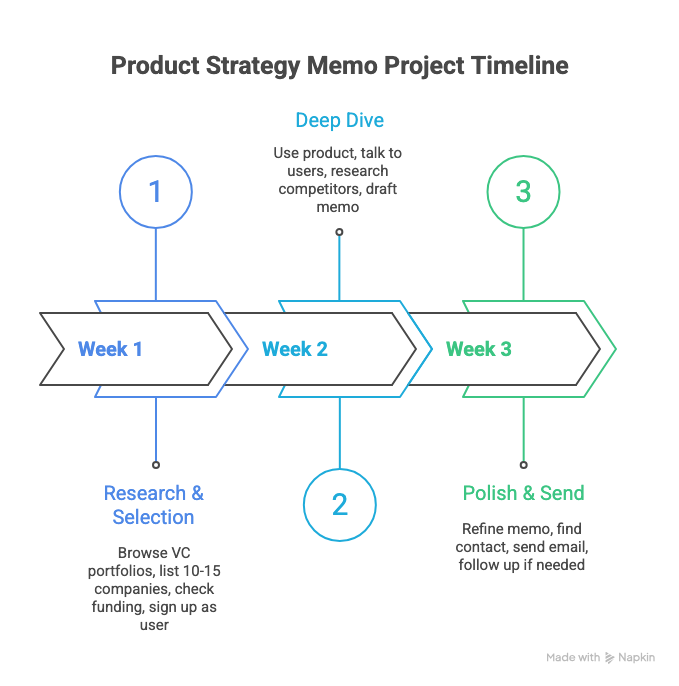
Making It Practical: Your Action Plan
Here's how to actually do this:
Week 1: Research & Selection
- Spend 2-3 hours browsing VC portfolio pages
- Make a list of 10-15 companies that genuinely interest you
- Check their recent funding announcements
- Look at their products and sign up as a user
Week 2: Deep Dive on 2-3 Companies
- Use their product extensively
- Talk to 3-5 users (online communities, LinkedIn, friends who might use it)
- Research their competitors
- Read any blog posts or interviews with their founders
- Start drafting your Product Strategy Memo
Week 3: Polish & Send
- Refine your memo until it's sharp and specific
- Find the right person to send it to (founder, Head of Product, PM lead)
- Send via email or LinkedIn with a short intro
- If you don't hear back in 5-7 days, follow up once
Don't try to do this for 10 companies at once. Pick 2-3 you're genuinely excited about and go deep.
The Bottom Line
The best opportunities aren't always posted on job boards. They're hiding in VC portfolios, in recently funded companies, and in startups that haven't started hiring yet but would create a role for the right person.
Your job is to:
- Find these opportunities systematically
- Demonstrate that you understand their business and can provide value
- Show up with a Product Strategy Memo that makes them think "We need to talk to this person"
This approach takes more effort than clicking "Apply" on Naukri. But it also completely changes the dynamic.
Instead of being application #1,847, hoping to get noticed, you become the candidate who showed up with genuine insights and strategic thinking.
That's the kind of candidate startups actually want to hire.
And when you do get hired, it won't be because you fit a job description. It'll be because you demonstrated you can think strategically, execute tactically, and provide value from day one.
That's how you don't just get hired, that's how you set yourself up for success in the role.
Next Up: In Part 4, we'll cover how to prepare for actual PM interviews at Indian startups, including case studies, behavioral questions, and exactly what interviewers are looking for.