
Reading Controls
Customize your reading experience
Switch between light and dark themes
Adjust text size and spacing for comfort
What Interviewers Really Look For in a Behavioral Interview for Product Managers
What Interviewers Really Look For in a Behavioural Interview for Product Managers
Landing a Product Manager role at a top tech company isn't just about demonstrating your technical prowess or your ability to design a compelling product. While those are undoubtedly critical, the behavioural interview for Product Managers often serves as the ultimate differentiator. It's where interviewers peel back the layers to understand who you are as a leader, collaborator, problem-solver, and human being.
Many PM candidates spend countless hours perfecting their product sense and execution frameworks, only to falter when asked to "Tell me about a time you failed." This article will demystify the behavioural interview for Product Managers, reveal what top companies are truly looking for, and provide a practical playbook to help you ace it.
Why Behavioural Interviews Matter So Much for Product Managers
Unlike many other roles, Product Managers operate at the intersection of various functions – engineering, design, marketing, sales, and operations. They lead without direct authority, constantly influence stakeholders, navigate immense ambiguity, and are ultimately accountable for product success. Given this unique landscape, a PM's soft skills, resilience, and leadership style are as critical as their hard skills.
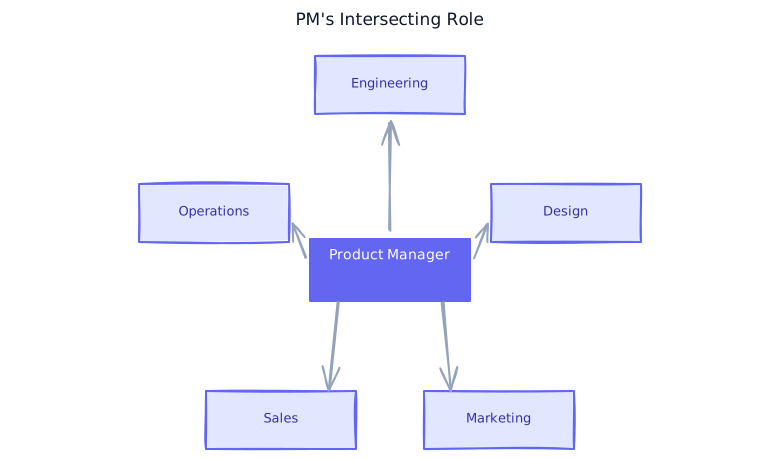
Behavioural questions aren't designed to trick you; they're designed to predict future performance based on past behaviour. Interviewers want to understand:
- 1. How you handle conflict
- 2. How you influence others
- 3. How do you deal with failure and learn from it
- 4. How do you manage difficult stakeholders
- 5. How do you prioritise under pressure
- 6. How you respond to ambiguity and uncertainty
- 7. How do you demonstrate ownership and accountability
These aren't hypothetical scenarios; they're real-world challenges PMs face daily. Your responses reveal your judgment, emotional intelligence, and ability to thrive in a complex, often ambiguous environment.
The Core PM Competencies Interviewers' Probe
While questions vary, interviewers are generally trying to assess a few key behavioural competencies that are non-negotiable for successful Product Managers:
Influence Without Authority
As a PM, you rarely have direct reports, yet you're responsible for guiding entire cross-functional teams. Interviewers want to see how you rally people around a vision, persuade sceptical stakeholders, and drive alignment without relying on hierarchical power. They look for examples where you used data, empathy, clear communication, and strategic framing to get others on board.
Dealing with Ambiguity & Uncertainty
The product world is rarely clear-cut. PMs constantly operate with incomplete information, shifting priorities, and evolving market conditions. Interviewers want to know how you bring structure to chaos, make informed decisions with limited data, adapt to change, and maintain composure when the path forward isn't obvious.
Cross-Functional Collaboration & Conflict Resolution
PMs are the glue that holds product teams together. You'll work closely with engineers, designers, researchers, and business leaders, each with their own goals and perspectives. Interviewers assess your ability to foster strong relationships, facilitate productive discussions, resolve disagreements constructively, and prioritise team success over individual wins.
Ownership, Accountability, & Resilience
When things go wrong, a great PM takes ownership, learns from mistakes, and drives solutions. Interviewers look for instances where you took responsibility, demonstrated perseverance in the face of setbacks, and showed a growth mindset. They want to see that you can bounce back from failure and extract valuable lessons.
Strategic Thinking & Prioritisation
While often tested in product sense interviews, behavioural questions can also reveal how you connect daily tasks to broader strategic goals. Interviewers might ask about how you've balanced competing priorities, said "no" to good ideas for the sake of great ones, or adapted your strategy in response to new information.
Empathy & User Focus
At the heart of every great product is a deep understanding of the user. Behavioural questions can explore how you champion the user, incorporate their feedback, and demonstrate empathy not just for customers, but also for your team members and stakeholders.
Your Secret Weapon: The STAR Method
The single most effective framework for answering behavioural questions is the STAR method. It provides a structured way to tell a compelling story that highlights your skills and impact.
- S - Situation: Set the scene. Briefly describe the context, who was involved, and when/where it happened. Keep it concise.
- T - Task: Explain your specific responsibility or goal in that situation. What needed to be accomplished?
- A - Action: This is the most crucial part. Detail the specific steps you took to address the situation or complete the task. Use "I" statements. Explain your thought process and the rationale behind your decisions.
- R - Result: Describe the outcome of your actions. What happened as a direct consequence of what you did? Quantify the results whenever possible (e.g., "increased user engagement by 15%," "reduced bug reports by 20%," "saved 10 engineering hours"). Explain what you learned from the experience.
The STAR method ensures your answers are clear, comprehensive, and directly address the interviewer's underlying question, demonstrating your competence and impact.
Crafting Compelling Stories: A Practical Playbook
Preparing for the behavioural interview for Product Managers isn't about memorising answers; it's about having a repertoire of well-structured stories ready to deploy.
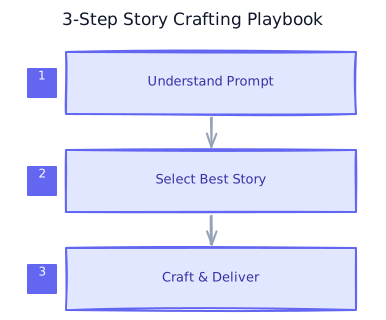
Step 1: Brainstorm Your Experiences
Think back through your career. What were your biggest challenges? Your proudest achievements? Times you failed? Conflicts you navigated? Projects where you had to influence others? Situations where you dealt with significant ambiguity? Make a list of 8-10 key experiences.
Step 2: Select the Right Stories
For each experience, identify which core PM competencies it best demonstrates. Aim for a diverse set of stories that can be adapted to various questions. For example, a story about a failed feature launch could highlight ownership, learning from failure, and resilience.
Step 3: Refine with STAR
For each selected story, apply the STAR method meticulously. Write it out, then practice saying it aloud. Focus on:
- Clarity and conciseness in S and T.
- Specificity in A – what you did, not what the team did.
- Quantifiable impact in R – numbers speak louder than words.
- The "so what?" – what did you learn or how did it change your approach?
Mini Case Study: Influencing Without Authority
Let's take a common behavioural question for a Product Manager:
"Tell me about a time you had to influence a cross-functional team to adopt a new approach or prioritize a feature that wasn't immediately popular."
Here's how you might apply STAR:
- S - Situation: "At my previous company, we were developing a new social sharing feature for our mobile app. The engineering team initially favoured a simpler, faster-to-implement technical architecture (Option A) that would get the feature out quickly. However, based on user research and our long-term product vision, I knew that a more robust, albeit initially slower, architecture (Option B) was crucial for future scalability and integration with other upcoming features."
- T - Task: "My task was to convince the engineering lead and key architects to pivot from their preferred Option A to my proposed Option B, ensuring we built a foundation that supported future growth without causing resentment or significant delays."
- A - Action: "I started by gathering data. I analysed competitors' solutions, projected future integration needs, and quantified the potential technical debt and refactoring costs associated with Option A over the long term. I then scheduled a dedicated working session with the engineering lead and two senior architects. Instead of presenting my solution as a mandate, I framed the discussion around our shared goal: delivering the best long-term value for users and the business. I presented the data clearly, articulated the strategic risks of Option A, and highlighted the long-term benefits and potential for future innovation with Option B. I listened actively to their concerns about timelines and resource allocation, acknowledging their expertise. Based on their feedback, I proposed a phased implementation plan that allowed for some immediate progress on core functionality while setting up the more scalable foundation. I also offered to work with them to re-prioritise other items in the backlog to free up bandwidth."
- R - Result: "After a constructive discussion, the engineering team agreed to adopt the modified Option B with the phased approach. This decision, while adding an initial two weeks to the development cycle, ultimately saved an estimated two months of refactoring effort within the next year. More importantly, it enabled us to launch two major feature extensions seamlessly in subsequent quarters, which directly contributed to a 10% increase in user engagement for that product line and avoided significant technical debt. The team felt heard and valued, and our collaborative relationship strengthened."
Common Behavioural Questions for PMs (and How to Approach Them)
Be prepared for variations of these:
- "Tell me about a time you failed." Focus on what you learned and how you applied that learning. Don't blame others.
- "Describe a difficult stakeholder relationship and how you managed it." Show empathy, proactive communication, and your ability to find common ground.
- "How do you handle disagreement with your manager?" Emphasise respectful discourse, data-driven arguments, and ultimately, alignment with the decision made.
- "Tell me about a time you had to pivot your product strategy." Highlight your adaptability, data analysis skills, and how you communicated the change.
- "Describe a time you took a risk that didn't pay off." As with failure questions, focus on the rationale for the risk and the lessons learned.
- "How do you prioritise when you have competing demands from different teams?" Discuss your framework (e.g., impact vs. effort, strategic alignment), how you communicate trade-offs, and involve stakeholders.
- "Tell me about a time you had to make a tough decision with incomplete information." Demonstrate your ability to gather critical data, identify assumptions, weigh pros and cons, and communicate the rationale and potential risks.
Dos and Don'ts for Your Behavioural Interview
Do:
- Be Authentic: Share real experiences. Interviewers can spot rehearsed, inauthentic answers.
- Quantify Your Impact: Use numbers whenever possible to demonstrate the tangible results of your actions.
- Use the STAR Method: It's your roadmap to clear, compelling answers.
- Focus on "I": Emphasise your specific contributions, not just what the team did.
- Prepare a Story Bank: Have 8-10 diverse stories ready for adaptation to various questions.
- Be Reflective: Always include what you learned or how you grew from the experience.
- Show Enthusiasm: Your passion for product management should shine through.
Don't:
- Blame Others: Even in conflict or failure stories, focus on your role and actions.
- Generalise: Avoid vague statements like "I always do X." Provide specific examples.
- Ramble: Keep your answers concise and to the point (aim for 2-3 minutes per STAR story).
- Make Excuses: Take ownership of your part in any negative outcome.
- Lie or Exaggerate: Integrity is paramount. Your stories should be truthful.
- Underestimate Preparation: Behavioural interviews are often underestimated but are crucial.
Conclusion
The behavioural interview for Product Managers is a critical hurdle, designed to assess the human element of your leadership and problem-solving abilities. By understanding the core competencies interviewers are seeking, mastering the STAR method, and diligently preparing a diverse set of compelling stories, you can confidently showcase your unique capabilities and significantly increase your chances of landing that dream PM role.
Remember, practice makes perfect. Refine your stories, articulate your actions, and quantify your impact. For personalised practice and feedback on your behavioural interview skills, consider joining a mock interview session at pminterviewprep.club. We're here to help you shine.