Reading Controls
Customize your reading experience
Switch between light and dark themes
Adjust text size and spacing for comfort
Getting Hired at an Indian Startup: Final Pointers for Success
Getting Hired at an Indian Startup: Final Pointers for Success
You've read the first four blogs. You know how to find opportunities, craft memos, do outreach, and handle calls.
But here's the uncomfortable truth: knowing what to do and actually succeeding are two different things.
I've seen people execute every tactic in this series perfectly and still not get hired. I've also seen people who only implemented half of these ideas land amazing roles.
What's the difference?
It's not luck. It's the subtle behaviors, mindsets, and skills that separate people who get offers from people who just get close.
This is Part 5, the final part in our series on "Getting Hired at an Indian Startup". If you haven't read Part 1, Part 2, Part 3, and Part 4, start there. This blog assumes you've already internalized the core strategies.
The Foundation: Prerequisites for Success
Before we dive into final pointers, let's address the elephant in the room.
No amount of outreach tactics will compensate for weak product skills.
If you don't have solid product thinking, frameworks for solving problems, and genuine curiosity about how products work, all the cold emails in the world won't save you.
This isn't meant to discourage you. It's meant to redirect your focus.
The tactics in this series work because they help you demonstrate skills you already have. They don't replace those skills.
So before you start sending 50 cold emails, ask yourself honestly:
- Can I break down a product problem into clear hypotheses?
- Do I understand basic product metrics and how to measure success?
- Can I think through trade-offs between different solutions?
- Am I genuinely curious about why products succeed or fail?
If you're not confident in these areas yet, spend time building these skills first. Use our platform at PM Interview Prep Club, practice case studies, analyze products you use daily, read product teardowns, and talk to PMs about their work
Strong product sense + strategic outreach = Success Weak product sense + strategic outreach = Wasted effort
Now, assuming your product skills are solid, let's talk about the subtle things that matter.
Final Pointers That Separate Good from Great
These are the nuances that most guides don't cover. They're small things that have an outsized impact.
Don't Act Desperate (Even If You Are)
I get it. You've been searching for 6 months. Your savings are running low. You need this job. But desperation repels opportunities.
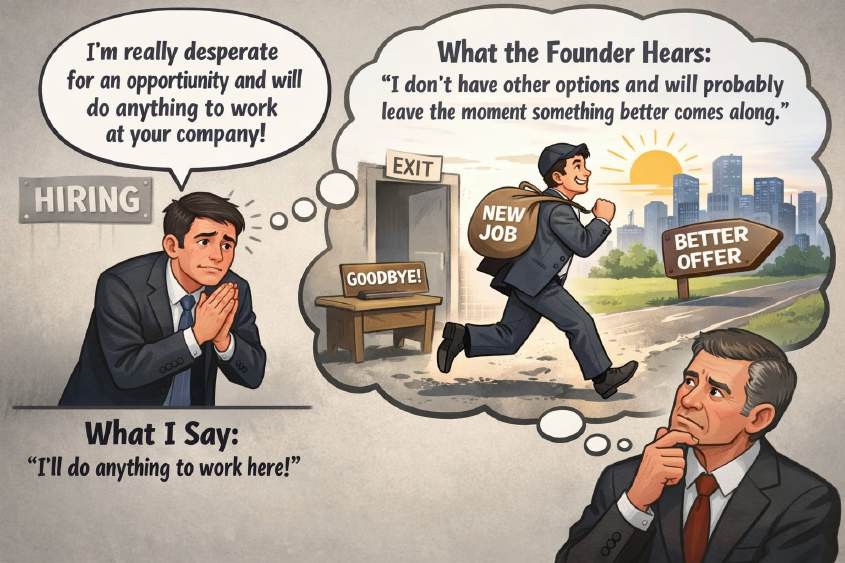
When you write: "I'm really desperate for an opportunity and will do anything to work at your company," what the founder hears is: "I don't have other options and will probably leave the moment something better comes along."
Instead, communicate enthusiasm without desperation:
Don't say: "I've been looking for months and would be grateful for any opportunity."
Say: "I'm specifically excited about what you're building in [sector] because [genuine reason]. I think the challenges you're solving around [specific problem] are fascinating."

See the difference? The second shows genuine interest in THEM, not just desperation for A JOB.
Even if you're financially stressed, maintain the posture of someone who's choosing carefully, not begging for anything.
This isn't about being fake. It's about framing. You ARE choosing carefully, you're choosing to pursue startups that genuinely interest you rather than accepting any corporate job.
Show Your Gratitude (Without Being Weird)
When someone responds to your cold email, takes a call with you, or introduces you to someone, acknowledge it.
Simple, genuine thank-yous matter:
"Thanks for taking the time to chat yesterday. I know you're juggling a million things, so I really appreciate you making space for this conversation."
But don't overdo it. One genuine thank-you is perfect. Five "thank you so much!!!" messages make you seem inexperienced.
And definitely don't send gifts or do anything that feels like you're trying too hard. Keep it professional and authentic.
Send Emails Proactively (That Have Nothing to Do With Your Job Search)
Here's a move almost nobody makes: reach out to founders when you DON'T need anything. Example: You've been following a startup for a few months. They just announced a Series A. Send this:
"Hi [Founder Name],
Saw the news about your Series A, congrats! Really excited to see [Company Name] scaling. I've been following your journey since [whenever,] and it's been cool to watch the product evolve.
No ask here, just wanted to say congrats. Best, [Your Name]"
That's it. No memo attached. No job asked. Just a genuine congratulations.
Two months later, when they're actually hiring, and you reach out with your memo, they'll remember: "Oh, this is that person who sent the nice note. Not just another job seeker."
Other proactive email opportunities:
- When they launch a new feature
- When they're mentioned in a major publication
- When they announce a new partnership
- When their founder gives a talk or writes a blog post
The key: these emails must be genuine. If you're only doing this as a tactic, it will feel manipulative. Do it because you're actually following companies you care about.
Don't Bullshit. Ever.
If you don't know something, say you don't know. If you made a mistake, own it.
If you're not sure about something, say you're not sure.
Startup founders have incredibly good bullshit detectors. They've dealt with investors, vendors, and employees who've lied to them. They can smell inauthenticity from a mile away.
I've seen candidates lose opportunities because they:
- Exaggerated their role on a projectClaimed expertise they didn't haveMade up data to support an argumentPretended to know a framework they'd never heard of
The startup world is small. The Indian startup world is REALLY small. Your reputation matters more than any single job opportunity.
When in doubt, choose honesty over looking good.
Be Yourself (The Professional Version)
Don't try to become someone you're not.
If you're naturally analytical and introverted, don't force yourself to be the loud, charismatic person in the room. Play to your strengths.
If you're from a non-traditional background (didn't study at IIT, didn't work at a big tech company), don't apologize for it. Frame it as your unique advantage.
One of our mentees was a CA (Chartered Accountant) who wanted to transition into product. Instead of hiding his finance background, he leaned into it:
"Most PMs focus on user engagement but don't deeply understand unit economics. My CA background means I can think about product strategy through both a user lens and a business profitability lens simultaneously."
He got hired at a fintech. His "disadvantage" became his differentiator.
Find your unique angle. Don't try to be a generic "PM candidate."
Be Open to Work Trials
Some startups will want you to do a work trial with them for a week or two (sometimes paid, sometimes unpaid) before making a full-time offer.
Many candidates see this as exploitation. Sometimes it is. But often, it's a startup being cautious because hiring mistakes are expensive.
If the trial is reasonable (1-2 weeks, working on a real project, with clear evaluation criteria), consider it.
Why this works in your favor:
- It's easier to say yes to a trial than to a full-time hireYou get to evaluate them, too (is this actually a place you want to work?)Once you're working with them, you have a massive advantage over external candidatesIf it doesn't work out, you've learned a ton Red flags for trials:Asking you to work for more than 2 weeks for freeNo clear scope or evaluation criteriaAsking you to build entire features with no supportVague promises about "maybe hiring you if it works out."
But if it's structured properly, a work trial can be your foot in the door.
Be Open to Being an Independent Contractor
Not every startup can afford a full-time PM immediately. But they might be able to afford a contractor for a few months.
If a founder says, "We love what you're proposing, but we don't have a budget for a full-time hire right now," respond with:
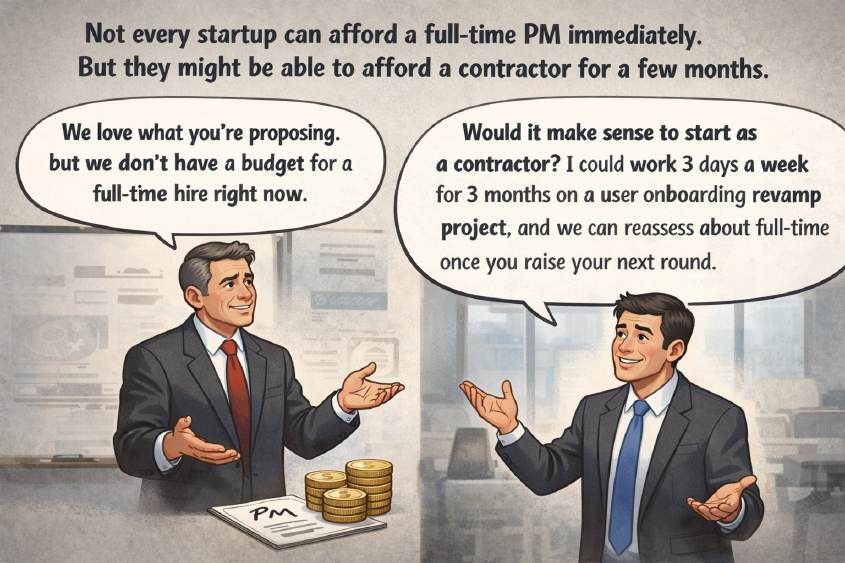 "Would it make sense to start as a contractor? I could work 3 days a week for 3 months on [specific project], and we can reassess about full-time once you raise your next round."
This does three things:
- Removes their risk
- Gets you in the door
- Let's see you prove yourself
Three months later, when they do have a budget, who do you think they'll hire? The person who's already embedded in the team and delivering results, or a stranger from a job board?
Obviously, make sure you can financially afford this. If you need a full-time income immediately, contractor work might not work. But if you have a runway of 4-6 months, this can be a smart move.
Lead With Value (The Unsolicited Free Work Approach)
This is controversial, but it works.
Sometimes, instead of asking for a call, just do something valuable and send it to them.
One of our mentees wanted to work at a B2C fashion brand. Instead of emailing them, asking for a call, she:
- Ordered their productCreated an Instagram campaign concept specifically for Tier 2 city audiences (her background)Made 3 sample posts with copy and visualsSent it to them with: "Made these as a thought experiment about how you could expand beyond metros. No ask, just thought you might find it interesting."
They called her the same day.
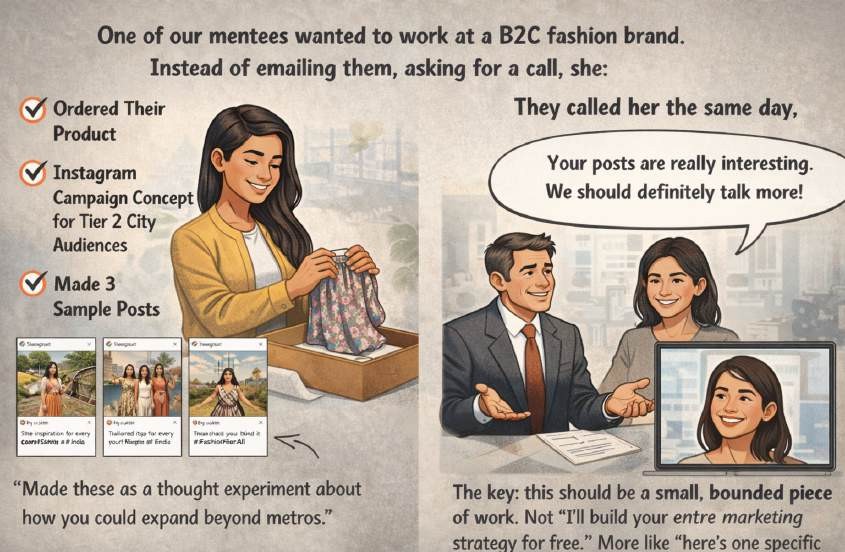
The key: this should be a small, bounded piece of work. Not "I'll build your entire marketing strategy for free." More like "here's one specific idea, fully mocked up."
Don't Let Your Hopes Get Too High Too Early
This is hard, but important.
You'll have conversations that go really well. The founder will say, "This is great, let's definitely move forward." You'll start imagining yourself working there.
Then two weeks pass. No response. You follow up. Nothing. What happened? Maybe:
- They got busy with a product crisisTheir funding round fell throughThey decided to pause hiringThey found someone else It's not personal. It's just startup life.
Protect yourself emotionally: don't count on anything until you have a written offer.
Keep applying to other companies even when one conversation is going well. Don't stop your outreach momentum until you've actually signed an offer letter.
This isn't pessimism. It's realism.
If You're Sending 100s of Emails With No Luck, Audit Your Process
If you've sent 100+ well-crafted emails with memos and you're getting zero responses, something is wrong.
Time to audit:
Check your LinkedIn profile
- Does it look professional?Is there a clear headline?Do you have a photo?Are there any red flags (job-hopping every 3 months, unexplained gaps)?
Review your memos
- Are they actually specific, or generic advice?Have you had someone else read them for honest feedback?Are they solving real problems or just listing features?
Examine your target companies
- Are you targeting companies that actually need PMs at their stage?Are you going after super competitive companies where everyone wants to work?Have you tried less "sexy" but still interesting startups?
Evaluate your email approach
- Are you personalizing each email or using templates?Are you following up?Are you finding the right contact person?
Consider your skill gaps
- Do you actually have the product skills required?Can you articulate your thinking clearly?Are you asking people for honest feedback?
Sometimes the problem isn't your approach, it's your readiness. If you're not getting any traction after 100+ attempts, it might be time to spend 2-3 months building stronger product skills before going back to outreach.
Get honest feedback from PMs you respect. Join our community at PM Interview Prep Club and practice with mentors. Do mock interviews. Build your product sense.
Then try again with sharper skills.
Handling Rejection and Building Resilience
Let's talk about what nobody wants to talk about: rejection. You're going to get rejected. A lot.
- Emails that get no responseCalls that go well but lead nowhereInterviews where you thought you nailed it, but didn't get the offerOffers that get rescinded because the startup's funding fell through
This isn't because you're not good enough. It's because startup hiring is chaotic, unpredictable, and full of factors outside your control.
How to stay sane:
- Treat it like a numbers game. Track your metrics: emails sent, responses received, calls scheduled, interviews completed. Focus on the process, not just outcomes. If you're getting 10- 15% response rates, you're doing fine. Keep going.
- Celebrate small wins. Got a response to your cold email? That's a win. Had a good conversation, even if it didn't lead to a job? That's a win. Got feedback from a founder? That's a win. Don't only celebrate job offers. Celebrate progress.
- Build a support system. Job searching alone is depressing. Find others in the same boat. Join communities (like ours), share struggles, celebrate each other's wins. It makes a massive difference.
- Take breaks. If you've been grinding for 3 months straight, take a week off. Seriously. Your mental health matters more than applying to 5 more companies this week.
- Remember why you're doing this. You're not just trying to get any job. You're trying to build a career doing work you actually care about at companies that are building interesting things. That's worth the struggle.
The Mindset That Wins
After coaching dozens of people through this process, I've noticed a pattern in those who succeed.
It's not about being the smartest or having the best resume.
It's about treating the job search itself like a product problem.
- They experiment with different approachesThey track what works and what doesn'tThey iterate based on feedbackThey stay curious even when things aren't workingThey focus on inputs (effort, quality, consistency), not just outputs (offers) The people who fail? They:Do the same thing repeatedly, hoping for different resultsGive up after a few rejectionsBlame external factors instead of improving their approachFocus only on outcomes and get demoralized when they don't come quickly
Treat your job search like a product you're optimizing. What would a good PM do?
Making It Practical: Your Final Checklist
Before you embark on this journey, make sure you have:
Skills Foundation:
- Solid product thinking and frameworksAbility to analyze products and identify opportunitiesClear communication skills (written and verbal)Basic understanding of metrics and analytics
Tactical Preparation:
- Target list of 30-50 companiesProduct Strategy Memo template and approachCold email template that's value-driven60-second pitch preparedTracking spreadsheet set upLinkedIn profile optimizedPortfolio or work samples if relevant
Mindset & Approach:
- Realistic expectations about response ratesEmotional resilience to rejectionsGenuine interest in startups, not just "getting a job"Willingness to follow through consistentlyOpenness to non-traditional paths (contractor, work trials)
If you have all of these, you're ready. If you don't, work on the gaps first. The Bottom Line: It's Doable, But It Takes Work
Let's be honest about what this series is asking you to do:
- Research 30-50 companies thoroughlyCraft customized memos for eachSend personalized emails and follow up consistentlyTake calls and demonstrate strategic thinkingHandle rejection and keep goingPotentially work for free or as a contractor initially That's a LOT of work.
Most people won't do it. They'll read this series, think "this is interesting," and then go back to clicking "Apply" on job boards.
That's exactly why it works for those who actually do it.
The Indian startup ecosystem is growing rapidly. There are more opportunities now than ever before. But there's also more competition.
The difference between candidates who land great roles and those who struggle isn't talent or credentials. It's effort, strategy, and consistency.
You've read all five blogs in this series. You know:
- Why normal applications don't work (Blog 1)How to stand out with strategic tactics (Blog 2)How to find and pitch the right opportunities (Blog 3)How to master outreach and calls (Blog 4)How to handle the subtle nuances that matter (Blog 5)
Now the question is: will you actually do it?
Most won't. They'll bookmark this series and never look at it again. Some will try for a week, get discouraged, and give up.
A small percentage will commit to the process, execute consistently for 2-3 months, and land roles at startups they're genuinely excited about.
Which group will you be in?
Your Next Steps
Don't let this be another thing you read and forget.
This week:
- Audit your product skills honestly. If there are gaps, commit to 30 days of focused improvement before starting outreach.
- If your skills are solid, build your target list of 30-50 companies using the methods from Blog 3.
- Pick the top 3 companies from that list and start researching them deeply.
Next week:
- Craft Product Strategy Memos for those 3 companies.
- Get feedback from someone who knows the product (a PM friend, a mentor from our community, anyone who can give honest input).
- Refine the memos based on feedback.
Week 3:
- Send your first round of outreach emails.
- Follow up with anyone who doesn't respond within 7 days.
- Take any calls that come in and execute the frameworks from Blog 4.
Keep going for 8-12 weeks.
That's the timeframe you should commit to. Not one week. Not one month. 8-12 weeks of consistent effort.
If you do this, you will get interviews. You will have meaningful conversations with founders. And you will very likely get offers.
Will it be easy? No.
Will it be guaranteed? No. Will it be worth it? Absolutely.
Because when you do land that role at a startup you're genuinely excited about, working on problems you care about, with people who chose you because they saw your potential, all of this effort will make sense.
You won't just have a job. You'll have a career trajectory that you actively chose and earned.
That's what this series is about.
Not just getting hired. But getting hired the right way, at the right place, for the right reasons. Now go do the work.
This is the end of the 5-part series on "Getting Hired at an Indian Startup."
If this series helped you, share it with someone else who's struggling with their job search.
And if you successfully land a role using these tactics, reach out and let us know. We'd love to hear your story.
Want more support on your PM journey? Join the PM Interview Prep Club, where we help early PMs build product skills, practice cases, and navigate the job search with personalized guidance.
Good luck. You've got this.