Reading Controls
Customize your reading experience
Switch between light and dark themes
Adjust text size and spacing for comfort
Build Your Product Muscle: A 3-Step Workout for Aspiring PMs
Build Your Product Muscle: A 3-Step Workout for Aspiring PMs
Product Management isn’t just about memorizing frameworks; it’s about training your brain to think differently. Just like going to the gym, developing "Product Sense" requires consistent repetition and the right form.
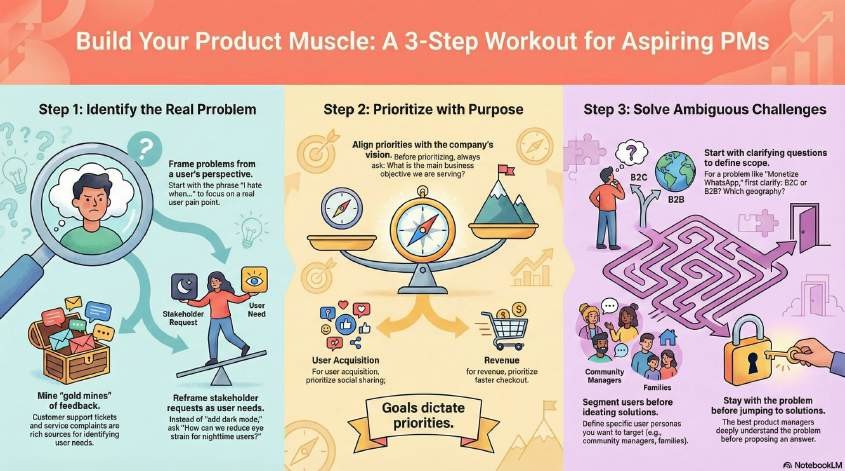 In our recent "Build Your Product Muscle" session at the PM Interview Prep Club, we broke down the product mindset into a three-step workout. Whether you are preparing for a rigorous interview or looking to sharpen your skills on the job, here is your study guide to mastering the product lifecycle.
Step 1: Identify the Real Problem (The Warm-Up)
Most aspiring PMs make a fatal mistake early in interviews: they jump straight to the solution. A stakeholder asks for a feature, and the candidate immediately starts designing UI.
To build true product muscle, you must first exercise restraint.
- The "I Hate When..." Technique: As discussed in our session, an effective way to frame a pain point is starting with the phrase "I hate when..." followed by a specific issue. This forces you to step out of the "builder" mindset and into the user’s shoes.
- Mine the "Gold Mines": Don't just rely on your intuition. One of our community members highlighted that customer support tickets and service complaints are "gold
mines" for discovery. These aren't just annoyances; they are direct data points showing where your product is failing to meet expectations.
- Reframe the Ask: If a stakeholder demands "Dark Mode," don't just build it. Ask why. Is it because users are experiencing eye strain? Is it for battery saving? Understanding the root cause allows you to design a solution that actually solves the problem, not just the symptom.
Step 2: Prioritize with Purpose (The Heavy Lifting)
Once you have a list of problems, you can’t solve them all. This is where the heavy lifting happens: Prioritization.
In our session, we tackled the "100 Rupees" problem—how do you spend limited resources? The answer lies in the Company Vision.
- Goals Dictate Priorities: You cannot prioritize a feature without knowing what the business is trying to achieve right now.Scenario: If the company goal is User Acquisition, you might prioritize "Social Sharing" features.Scenario: If the company goal is Revenue, you must prioritize "Faster Checkout" to reduce drop-off rates.
- The Trade-off: As noted in our study guide, we prioritized "Faster Checkout" over "Loyalty Tiers" because it directly impacts conversion rates and removes friction from the critical path. Always tie your priority back to a business metric (KPI).
Step 3: Solve Ambiguous Challenges (The Endurance Run)
The final step is tackling the dreaded "Ambiguous Problem"—questions like "How would you monetize WhatsApp?"
These questions are designed to test your endurance and ability to navigate chaos.
- Clarify Before You Solve: Never answer a broad question immediately. As seen in our WhatsApp case study, you must first narrow the scope.Market: Are we talking about India, the US, or Global?User Type: Are we solving for B2B (Business API) or B2C (Everyday users)?Interaction: Are we focusing on 1-on-1 chats or community groups?
- Segment Your Users: You cannot build a product for "everyone." Define specific personas (e.g., "Community Managers" or "Large Families") and solve deeply for them.
🧠 Test Your Product Knowledge
Based on our recent session, can you answer these rapid-fire questions? (Check your answers at the bottom!)
- True or False: When a stakeholder requests a specific feature, your first job is to implement it as quickly as possible.
- RCA vs. Design: What is the core difference between a Root Cause Analysis (RCA) problem and a Product Design problem?
- The "Product" Scope: Can an internal employee onboarding process be considered a "product"?
Key Takeaways for Your Next Interview
- Be Vocal: Product Managers are expected to be the most vocal problem solvers in the room. Communicate your thought process constantly.Don't Assume: Even for ubiquitous products like WhatsApp, asking basic clarifying questions signals maturity, not ignorance.Think End-to-End: From the "Happy Path" to the edge cases, a good PM views the product holistically.
Ready to flex your product muscles with a community of peers? Join us for the next live session at pminterviewprep.club!
Quiz Answers:
- False. Your first job is to reframe the request into a user need/problem.
- RCA is about breadth (looking at the whole system, tech, and logistics to find a fault), while Design often focuses on a narrower user persona or use case.
- Yes. Any process can be treated as a product by applying the design thinking lifecycle to improve its quality and output.